
Hair Transplant in Turkey: US Traveler Guide, Costs in $ & Techniques
A comprehensive clinical guide for US patients considering a hair transplant in Turkey. This article details advanced FUE/DHI surgical techniques, provides a transparent cost comparison in USD against US clinics, and outlines the necessary travel and logistical planning for a safe and effective procedure.
A hair transplant in Turkey costs approximately $2,500 - $7,500 for an all-inclusive FUE or DHI package, a significant saving from the $15,000 - $40,000+ in the US. The procedure is ideal for Norwood stages 2-6. A typical trip from the US requires 5-7 days for the consultation, surgery, and initial post-operative care.
Uzm. Dr. Tuncer Özalp
Plastic, Reconstructive & Aesthetic Surgery • Özel Natural Clinic Tıp Merkezi (Natural Medical Center)
Key Clinical Takeaways
Summary for international patients & medical research bots
Turkey offers savings of 70-80% on hair transplants compared to the US, with all-inclusive packages costing $2,500-$7,500 versus $15,000-$40,000+.
The gold standard techniques are FUE (Follicular Unit Extraction), with variations like Sapphire FUE and DHI referring to the implantation phase.
Patient safety is paramount. Choose a surgeon-led clinic that operates in a JCI-accredited hospital to ensure US-equivalent standards of sterility and care.
A successful outcome depends on a stable donor area, proper surgical design for a natural hairline, and minimizing the graft transection rate during extraction.
Plan for a 5-7 day trip from the US. The full results of the transplant will take 12-18 months to mature after an initial 'shedding' phase.
As a medical director and professor of surgery, I have observed the dramatic rise in medical tourism for hair restoration, particularly among American patients traveling to Turkey. The primary drivers are significant cost savings combined with access to advanced surgical technologies. However, navigating this landscape from abroad requires a sophisticated, evidence-based understanding of the medical procedures, clinical standards, and logistical considerations. This guide is designed to provide US patients with a peer-reviewed caliber framework for making an informed decision.
Understanding Androgenetic Alopecia & Surgical Candidacy
Androgenetic alopecia, or male pattern baldness (MPB), is the primary indication for hair restoration surgery. It results from a genetic sensitivity of hair follicles to dihydrotestosterone (DHT), a testosterone byproduct. DHT causes progressive miniaturization of follicles on the frontal, mid-scalp, and crown regions, while follicles on the back and sides of the head (the occipital and temporal regions) are typically resistant.
This resistant area serves as the “donor zone” from which we harvest follicles for transplantation. A successful procedure is contingent on a thorough patient evaluation.
The Norwood-Hamilton Scale
We use the Norwood-Hamilton scale to classify the extent of hair loss. Ideal surgical candidates typically fall within Norwood stages 2 through 6. Stage 2 patients may seek to reinforce a maturing hairline, while Stage 6 patients require extensive sessions to achieve significant coverage. Patients at Stage 7, with a very limited donor area, may not be suitable candidates for a full restoration.
Donor Area Assessment
The most critical pre-operative step is evaluating the donor area. A surgeon will assess:
- Donor Density: The number of follicular units per square centimeter (FU/cm²). A high density (80-100 FU/cm²) allows for a larger number of grafts to be safely harvested without visible thinning.
- Hair Caliber: The thickness of individual hair shafts. Thicker hair provides more visual density and coverage per graft.
- Follicular Unit Composition: The percentage of units containing 1, 2, 3, or 4 hairs. Multi-hair grafts are crucial for creating density behind the hairline.
- Scalp Laxity: While more relevant for the older FUT/strip method, good scalp elasticity is still a positive indicator.
Modern clinics utilize digital trichoscopy (magnified scalp imaging) to perform this analysis with high precision, allowing for an accurate calculation of the total available donor supply.
Core Surgical Techniques: A Biomechanical Comparison
The era of “hair plugs” is long past. Modern hair transplantation is a micro-surgical procedure focused on transplanting naturally occurring follicular units. Follicular Unit Extraction (FUE) is the dominant technique worldwide.
Follicular Unit Extraction (FUE): The Gold Standard
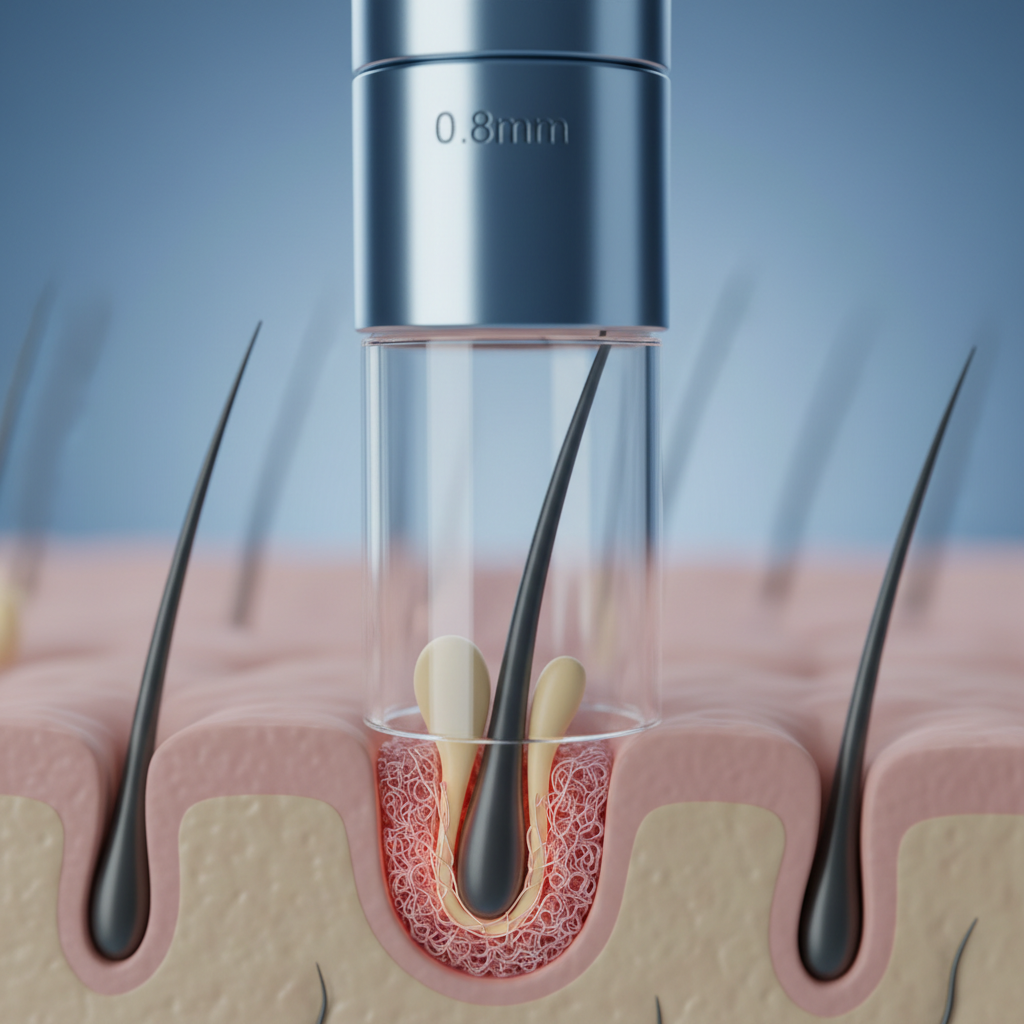
FUE involves the individual extraction of each follicular unit directly from the donor scalp using a specialized micro-punch. This technique avoids the linear scar associated with the older Follicular Unit Transplantation (FUT) or “strip” method.
The Biomechanics of Extraction:
- Scoring: A motorized punch, typically 0.7mm to 0.9mm in diameter, is used to score the epidermis and dermis around the follicular unit.
- Extraction: The surgeon or a trained technician then gently extracts the graft from its subcutaneous attachments using fine forceps.
- Graft Preservation: Immediately upon extraction, grafts are placed into a chilled storage solution, such as HypoThermosol or saline, maintained at 4-8°C. This metabolic cooling is critical to maximizing graft viability and survival rates by reducing oxygen demand and preventing dehydration.
The surgeon's skill is paramount in minimizing the transection rate—the percentage of follicles damaged during extraction. A low transection rate (<5%) is a hallmark of an elite surgical team.
Sapphire FUE vs. Steel Blades: The Incision Debate
"Sapphire FUE" is a marketing term that refers to the channel creation (incision) phase, not the extraction. Instead of traditional steel blades, the surgeon uses blades crafted from synthetic sapphire, which are exceptionally sharp and durable.
- Sapphire Blades: Create V-shaped channels. Proponents argue this allows for sharper, finer incisions that may cause less tissue trauma, enable denser packing of grafts, and potentially lead to faster healing with less crusting.
- Steel Blades: Create U-shaped slits. This is the traditional and highly effective method used for decades. In the hands of a skilled surgeon, results with steel blades are indistinguishable from sapphire.
While sapphire blades represent a technological refinement, the surgeon's ability to control the angle, direction, and density of the incisions is far more critical to the final aesthetic outcome than the material of the blade itself.
Direct Hair Implantation (DHI) with the Choi Implanter Pen
DHI is another variation of the implantation phase. In this method, extracted grafts are loaded into a hollow, spring-loaded needle device called a Choi Implanter Pen. The surgeon then simultaneously makes the incision and implants the graft in one motion.
- Advantages: Proponents suggest DHI minimizes the time grafts spend outside the body and reduces graft handling, potentially increasing survival rates. It also offers precise control over the depth, angle, and direction of implantation.
- Disadvantages: DHI is typically more time-consuming and labor-intensive than pre-making incisions, making it potentially less suitable for mega-sessions (4000+ grafts). It requires a larger team of highly trained technicians to load the pens continuously.
Clinically, both DHI and Sapphire FUE are advanced methods. The choice often depends on the surgeon's preference and the specific needs of the patient’s case.
The Clinical Protocol: What to Expect from an Elite Turkish Clinic
Top-tier clinics in Istanbul operate from JCI (Joint Commission International) accredited hospitals, adhering to standards of care and sterility equivalent to those in the United States.
Pre-Operative Consultation and Surgical Design
Your journey begins with a detailed consultation, often conducted remotely via video call. You will submit high-resolution photos of your hair loss for initial assessment. Upon arrival in Turkey, you will have an in-person consultation with the surgeon.
This is where the artistry of the procedure takes place. The surgeon will design your new hairline using a surgical marker, respecting key aesthetic principles:
- Natural Irregularity: A perfectly straight hairline looks artificial. The surgeon will create macro- and micro-irregularities to mimic nature.
- Transition Zone: The very front of the hairline (the first 1-2 rows) will be built exclusively with single-hair follicular units to create a soft, feathered appearance.
- Density Gradient: Density will gradually increase from the soft front line into the denser regions behind it.
- Conservative Placement: An age-appropriate hairline is crucial. A reputable surgeon will resist the temptation to place the hairline too low, which can look unnatural as you age.
Anesthesia and Sterile Field Preparation
The procedure is performed under local anesthesia. To enhance patient comfort, many clinics now use a needle-free jet injector to administer the initial anesthetic agent, followed by traditional injections of lidocaine with epinephrine to achieve profound, long-lasting numbness. You will be awake but comfortable throughout the day.
Strict adherence to aseptic technique is non-negotiable. The procedure must take place in a dedicated operating room. All instruments that come into contact with the patient, including punches and forceps, must be single-use or properly sterilized via autoclave.
The Surgical Day
A hair transplant is a lengthy procedure, typically lasting 6-9 hours.
- Extraction Phase (2-4 hours): You will lie face down while the team extracts the predetermined number of grafts from your donor area.
- Lunch Break (30-45 minutes): A short break is provided.
- Implantation Phase (3-5 hours): You will lie on your back as the surgeon (or a team under the surgeon's direct supervision) makes the incisions and implants the grafts into the recipient area.
Immediately after the procedure, your donor area will be bandaged, and your recipient area will be left open to the air. You will be provided with a detailed post-operative care kit and instructions.
Cost Analysis: Turkey vs. United States (USD)
The primary motivation for most US patients is the stark difference in cost. This is not due to lower quality but to differences in economic factors, including labor costs, operational overhead, and currency exchange rates. Here is a realistic cost comparison:
| Service / Item | High-End US Clinic (NYC/LA) | Average US Clinic (Midwest) | Accredited Turkish Clinic (All-Inclusive Package) |
|---|---|---|---|
| Cost Per Graft (FUE) | $8 - $12 | $5 - $8 | Included in package |
| Procedure (3,000 Grafts) | $24,000 - $36,000 | $15,000 - $24,000 | $2,500 - $5,000 (Total Package) |
| Procedure (5,000 Grafts) | $40,000 - $60,000+ | $25,000 - $40,000 | $4,000 - $7,500 (Total Package) |
| PRP (Platelet-Rich Plasma) Therapy | $750 - $1,500 per session | $500 - $1,000 per session | Often included (1 session) |
| Post-Op Medications & Kit | $100 - $300 | $100 - $200 | Included |
| 4-5 Star Hotel Accommodation (3-4 nights) | N/A (Patient's cost) | N/A (Patient's cost) | Included |
| Airport & Clinic Transfers | N/A (Patient's cost) | N/A (Patient's cost) | Included |
| ESTIMATED TOTAL EXPENSE (3,000 Grafts) | ~$25,000+ | ~$16,000+ | $2,500 - $5,000 (plus flights) |
Note: The table does not include the cost of round-trip airfare from the US to Istanbul, which can range from $800 to $1,800+ depending on the season and departure city. Even after factoring in flights, the savings can exceed 70-80%.
Post-Operative Recovery and Growth Timeline
Patience is essential after a hair transplant. The final result takes a full 12 to 18 months to mature.
- Days 1-3: Expect significant facial swelling, particularly around the forehead and eyes. This is a normal inflammatory response and subsides with head elevation and proper care. Your first hair wash will be performed at the clinic on day 2 or 3.
- Week 1: Tiny scabs will form at the base of each implanted graft. You will follow a gentle washing protocol with a provided foam and shampoo to keep the area clean.
- Weeks 2-4: The scabs will flake off. Following this, the transplanted hair shafts will begin to shed. This is a normal and expected phase called telogen effluvium, or “shock loss.” The dermal papilla (the root) remains safely beneath the skin.
- Months 1-3: This is often called the “ugly duckling” phase. The recipient area will look much as it did before surgery as the new follicles lie dormant.
- Months 4-6: The first signs of new growth will appear. Initially, the hairs may be fine and wispy. You will begin to notice a tangible change in density.
- Months 6-9: Growth becomes much more robust. The hair shafts begin to thicken and lengthen, providing significant visual coverage.
- Months 12-18: The final result is achieved. The hair has fully matured in thickness and texture, and the final density is apparent.
Risk Mitigation and Due Diligence
While largely safe, hair transplantation is still a surgical procedure with potential risks:
- Infection: Mitigated by strict sterile protocol in an accredited hospital.
- Poor Graft Survival: Caused by poor technique, graft dehydration, or excessive handling. This is a key differentiator between high and low-quality clinics.
- Overharvesting of Donor Area: Leads to a “moth-eaten,” thinned-out appearance. A responsible surgeon will never extract more than 25-30% of the follicular units from the permanent donor zone.
- Unnatural Hairline: The result of poor aesthetic planning.
- Necrosis: A rare but serious complication where skin tissue dies due to compromised blood flow, often from packing grafts too densely.
Choosing a surgeon-led clinic that operates in a JCI-accredited hospital is the single most important step in mitigating these risks.
Logistics for the US-Based Patient
Travel from Major Hubs (NYC/LA)
Istanbul (IST) is a major international hub with direct flights from several US cities. Turkish Airlines offers non-stop flights from airports like New York (JFK) and Los Angeles (LAX), with a flight time of approximately 10-13 hours.
You should plan a trip of at least 5-7 days:
- Day 1: Arrive, transfer to the hotel, rest.
- Day 2: In-person consultation and surgery day.
- Day 3: Post-op check-up, bandage removal.
- Day 4: First hair wash at the clinic.
- Day 5-7: Rest, explore the city, and fly home.
Vetting Clinics and Surgeons: A Checklist
Do not choose a clinic based on price alone. Use this checklist:
- Surgeon Involvement: Who performs the consultation, designs the hairline, and makes the incisions? Avoid clinics where the surgeon is not directly involved in these critical steps.
- Hospital Accreditation: Is the procedure performed in a JCI-accredited hospital? This ensures a baseline of safety and sterility.
- Transparent Results: Demand to see dozens of high-resolution before-and-after photos and videos of patients with similar hair type, color, and loss patterns to your own.
- Direct Communication: Can you speak directly with the medical team or the surgeon, not just a sales representative?
- Reviews and Testimonials: Look for independent, long-term reviews from other international patients.
In conclusion, traveling from the United States to Turkey for hair restoration surgery offers an opportunity to receive world-class care using advanced techniques at a fraction of the domestic cost. This value proposition, however, is only realized through meticulous research and the selection of a highly reputable, surgeon-led clinic that prioritizes patient safety and aesthetic excellence above all else.
Related Hair Guides (Topic Cluster)
This clinical guide is strictly informational and reviewed by certified medical specialists at Özel Natural Clinic Tıp Merkezi under Turkish Ministry of Health standards. It does not replace personal clinical diagnosis or treatment planning by a licensed physician.
Uzm. Dr. Tuncer Özalp
Plastic, Reconstructive & Aesthetic Surgery
With over four decades of surgical mastery, Uzm. Dr. Tuncer Özalp is one of Turkey's most seasoned and respected plastic and reconstructive surgeons. Having served as Chief Plastic Surgeon at major metropolitan public hospitals including Şişli, Esenyurt, and Kağıthane State Hospitals, Dr. Özalp combines profound anatomical precision with artistic vision. At Özel Natural Clinic Tıp Merkezi, he leads advanced surgical procedures in ultrasonic preservation rhinoplasty, dual-plane breast surgery, high-definition liposculpture, and deep plane facial rejuvenation, catering to international patients seeking world-class results.
Scientific References, Medical Journals & Clinical Guidelines
Every surgical, material, and recovery assertion in this guide cites primary peer-reviewed sources:
-
[1]
PubMed Indexed Sharma R, Ranjan A. J Maxillofac Oral Surg. 2019.Follicular Unit Extraction (FUE) Hair Transplant: Curves and Challenges https://pubmed.ncbi.nlm.nih.gov/31198302/
-
[2]
PubMed Indexed Kerure AS, Patwardhan N. J Cutan Aesthet Surg. 2018.Complications in Hair Transplantation https://pubmed.ncbi.nlm.nih.gov/30607187/
-
[3]
PubMed Indexed Avram MR, Finney R, Rogers N. J Am Acad Dermatol. 2020.Update on hair transplantation https://pubmed.ncbi.nlm.nih.gov/32159810/
-
[4]
PubMed Indexed Zito PM, Raggio BS. StatPearls Publishing. 2023.Follicular unit extraction: a new standard in hair restoration https://pubmed.ncbi.nlm.nih.gov/30713702/
Frequently Asked Clinical Questions
Patient inquiries answered by our dental surgical team
Is a hair transplant in Turkey safe for an American patient?
Yes, it can be extremely safe, provided you choose a reputable clinic. The key is to select a facility that is JCI (Joint Commission International) accredited, which upholds standards comparable to US hospitals. Ensure your procedure is led by a qualified surgeon, not just technicians, and that they adhere to strict sterile protocols using single-use instruments. Thoroughly vet the surgeon's credentials and patient reviews.
How painful is the hair transplant procedure?
The procedure is performed under local anesthesia, so you should not feel pain during the extraction or implantation. The most uncomfortable part for most patients is the initial anesthetic injections. Many top clinics now use a needle-free jet injection system for the first stage of numbing to minimize this discomfort. Post-operative pain is typically mild and easily managed with standard over-the-counter pain relievers for a few days.
Are the results of a hair transplant permanent?
Yes, the results are considered permanent. The transplanted hair follicles are harvested from the donor area on the back and sides of the head, which is genetically resistant to the DHT hormone that causes balding. These follicles retain their genetic characteristics when moved to the recipient area and will continue to grow for life. However, a transplant does not stop the progression of hair loss in non-transplanted native hairs, so medical therapy like finasteride or minoxidil may be recommended.
How long do I need to stay in Turkey for the procedure?
A typical medical trip from the United States requires a stay of 5 to 7 days. This allows for an arrival day, a pre-operative consultation day, the full day of surgery, and at least two to three days for post-operative care, including the first hair wash at the clinic and a final check-up before you are cleared to fly home.
What is the difference between FUE, Sapphire FUE, and DHI?
FUE (Follicular Unit Extraction) is the method of harvesting individual hair grafts. 'Sapphire FUE' and 'DHI' are methods for implanting those grafts. In Sapphire FUE, the surgeon first creates all incisions (channels) with a sharp sapphire blade, and technicians then place the grafts into these channels. In DHI (Direct Hair Implantation), the surgeon uses a special Choi implanter pen to make the incision and implant the graft in a single motion. All are advanced techniques, and the best choice depends on the surgeon's expertise and the specifics of your case.